An Executive Case Study
The 2026 World Cup
Brand Mobilization
The largest, fastest, and costliest brand-marketing push in the tournament's history — and the open question of whether anyone can yet prove it worked.
BeginContents
A two-part argument, walked through one verifiable claim at a time. Tap any line to jump straight to that section.
- The ArgumentThe two-part thesis: undeniable scale, unproven payoff.
- 01The ScaleAll the sponsorship money showed up — and showed up first.
- 02The Scope and the SpeedLike hosting a few dozen Super Bowls at once.
- 03The RolloutThe clutter the trade press warned about, on a calendar.
- 04The FlipThe loudest brands are not the most remembered.
- 05The Measurement GapCrowding erodes recall, and proof stays out of reach.
- 06The UpsideThe audience is already there to be won.
- In ClosingA real bet, still awaiting a real scoreboard.
- CitationsEvery figure traced to a published, attributable source.
Figures reflect sources published through June 2026.
The Argument
A bet placed in full view, with no scoreboard yet built
The 2026 World Cup arrives in North America as a commercial event without precedent. This study makes a two-part argument, and treats the second part as the more important one.
Part One — The scale is unprecedented, and it is verifiable
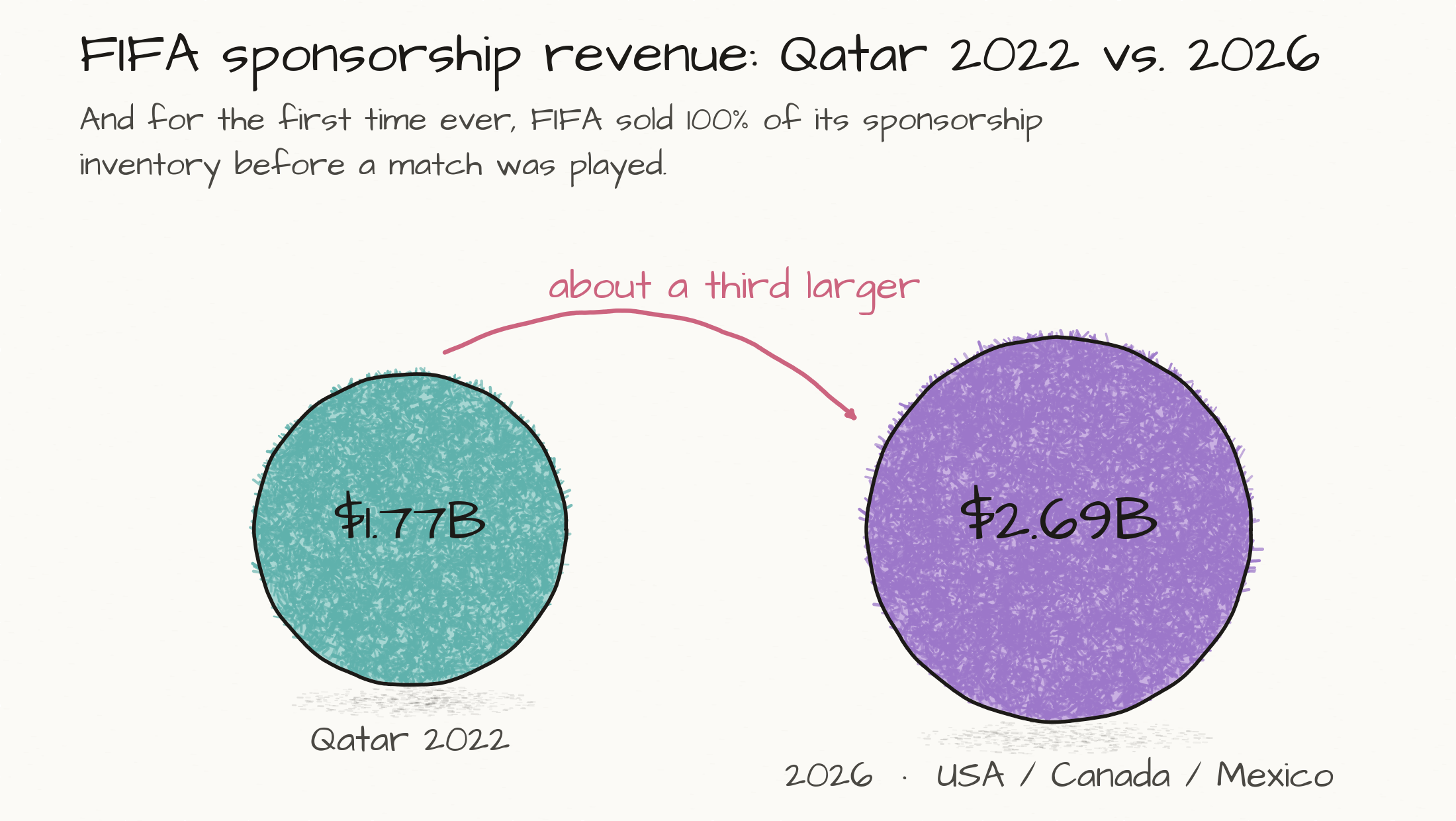
By every documented measure, this is the largest, fastest, and costliest brand-marketing mobilization the tournament has ever seen. For the first time, FIFA sold one hundred percent of its sponsorship inventory before a single match was played, at a reported figure near $2.4 to $2.8 billion — roughly a thirty-seven percent jump over Qatar 2022.1 United States brands moved from about thirty-six percent of the commercial base to roughly fifty-two percent.1 The competition itself grew by sixty-three percent, to 104 matches across sixteen cities in three countries.2 The money, the speed, and the risk are real, and they are documented.
Part Two — Scale flipped the game, and no one can yet prove the bet paid off
Showing up used to be the hard part. Now showing up is cheap; being noticed, being remembered, and proving it are the real costs. The brands that are loudest are not the ones that resonate.3 Crowding measurably erodes how well even established sponsors are remembered.4 And industry analysts expect that the great majority of marketers who invest in sports sponsorship will struggle to prove a return.5 The audience is genuinely there to be won — close to half of all United States adults, and well over half of younger ones, say they are interested.6 The upside is real. What does not yet exist is the toolkit to know whether the bet worked.
The pages that follow walk through the scale, the scope, the flip, the measurement gap, and the upside — one verifiable claim at a time.
01 · The Scale
The money showed up first, and all of it
FIFA generates roughly $13 billion across the 2023–2026 commercial cycle, and World Cups have historically supplied more than eighty percent of that revenue.7 What sets 2026 apart is not only the size of the sponsorship pool but its completeness. The reported $2.4 to $2.8 billion sold before kickoff stands against Qatar 2022's roughly $1.77 billion — the comparison shown below.8
The scale extends well past the rights fees. Tier-one FIFA partnership fees run an estimated $150 to $200 million, and more than $400 million across a full four-year cycle.9 When sponsor-side activation is added on top — the advertising, retail programs, and brand campaigns built around the sponsorship — the total marketing spend tied to the tournament is commonly estimated in the $6 to $8 billion range, applying the industry convention that activation runs well above the rights fee itself. That figure is an estimate, not a published total, and is labeled as such throughout this study.
02 · The Scope and the Speed
Like hosting a few dozen Super Bowls at once
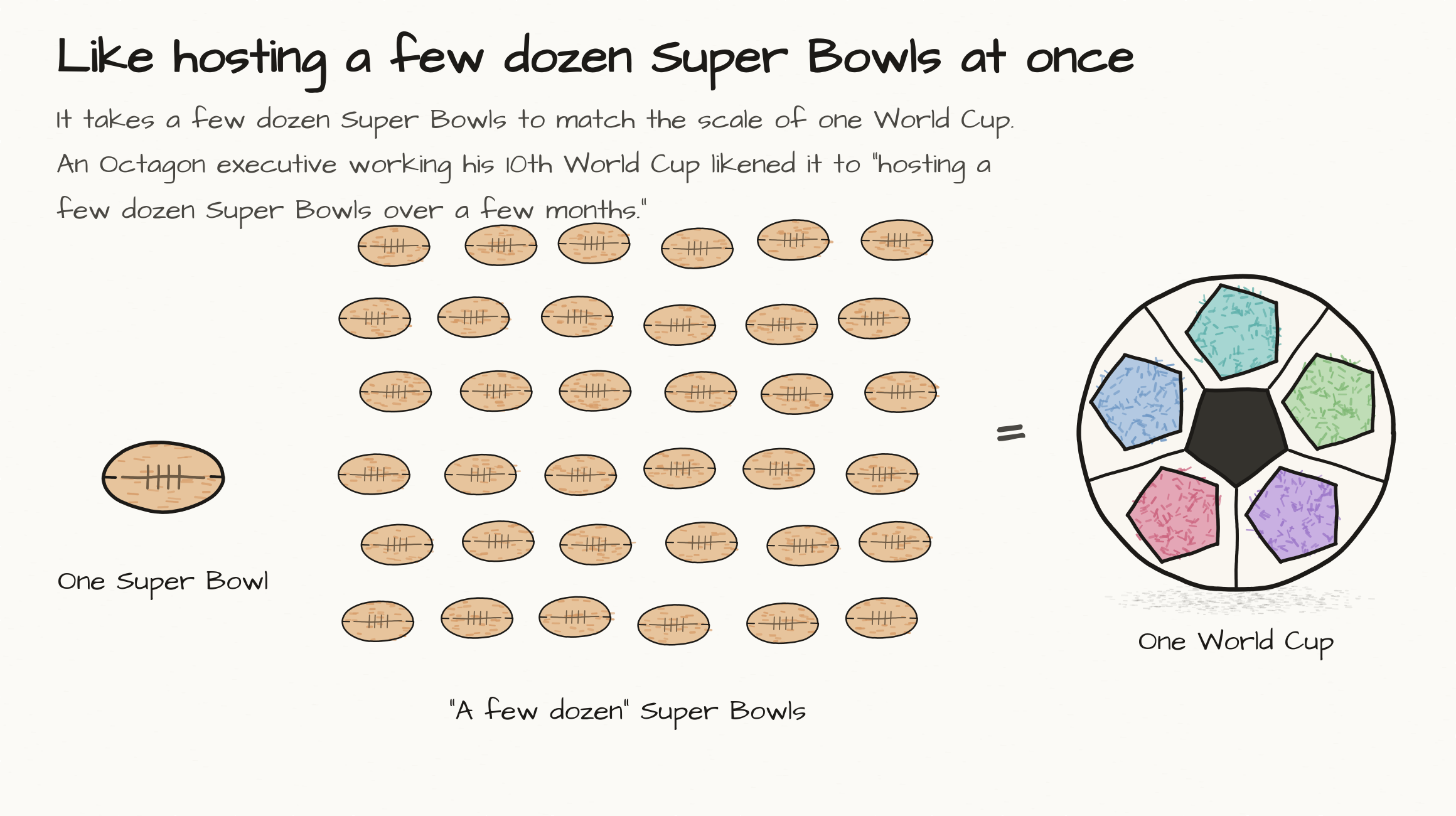
The tournament runs 104 matches over thirty-nine days, across sixteen host cities in the United States, Canada, and Mexico — fifty percent more teams than before and forty more games, in the first North America-friendly time zone since 1994.10 An Octagon executive vice president working his tenth World Cup described the commercial moment as "hosting a few dozen Super Bowls over a few months," and advised brands to avoid the clutter by getting out in front early; some began activating as early as the end of the prior year.10 A Genesco chief executive put it more bluntly: "there's more clutter than even a Super Bowl."10
The activations themselves convey the scope better than any single number. Lay's launched forty new flavors; Panini produced more than a billion stickers; Coca-Cola committed more than 300 million branded bottles; Diageo activated across thirty-six countries; and The Home Depot, the only home-improvement chain present in all three host countries, ran its "Build It Like Beckham" program across all sixteen markets.10 The defining feature is not any one campaign but the simultaneity of all of them.
03 · The Rollout
The clutter the trade press warned about, on a calendar
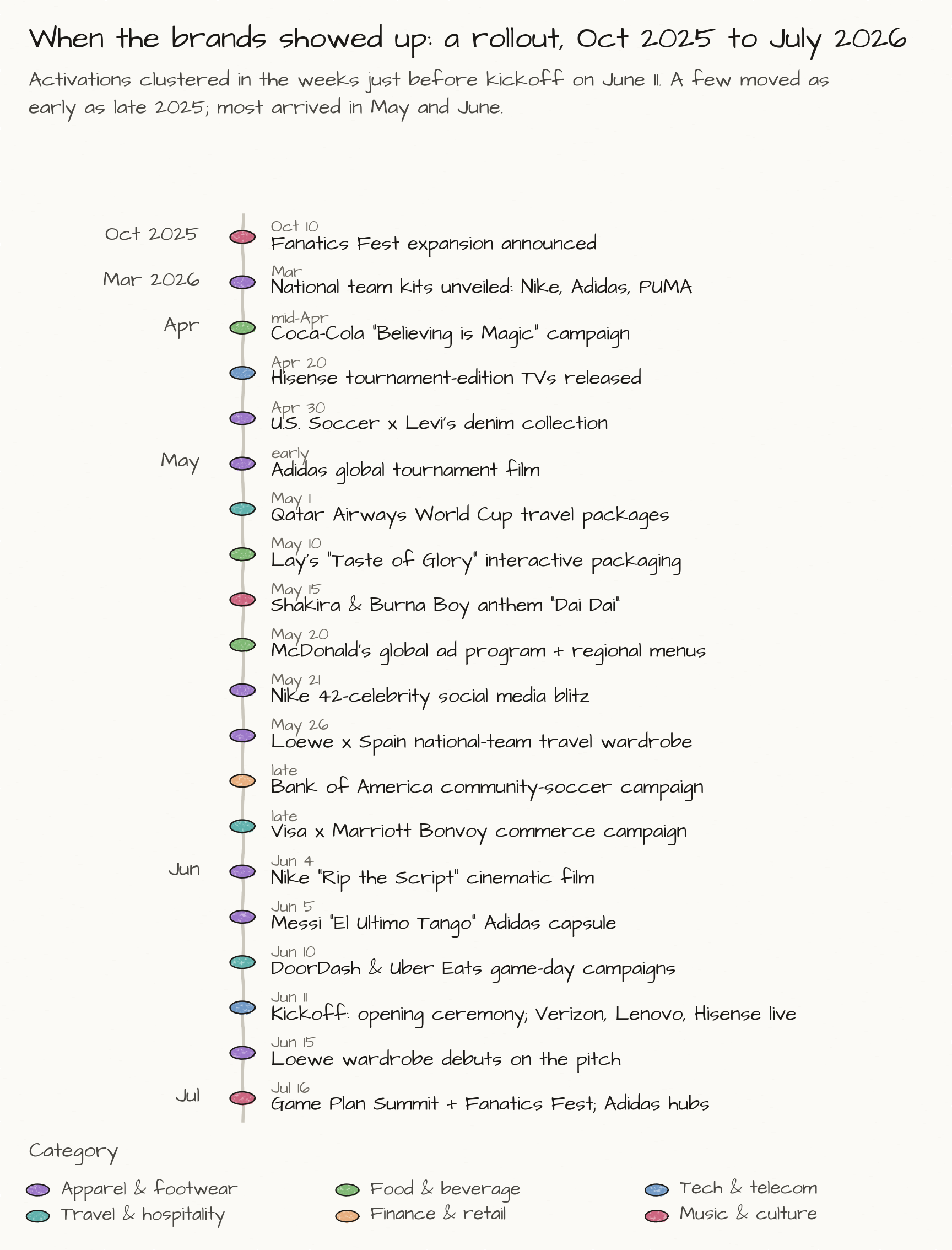
The simultaneity is easiest to see laid out in time. The activations below were compiled from public announcements; they show a rollout that began as early as late 2025 and then bunched heavily into May and June, in the weeks just before the June 11 kickoff — exactly the crowding the trade press described, and exactly the reason its advisers urged brands to get out in front of it early.10 The list is illustrative of the pace and breadth of the rollout, not an exhaustive schedule.
Why the timing
The bunching is not coincidence; it is the product of two forces colliding with a tournament half again as large as the last one. The first is structural and specific to 2026: North America's return. For the first time since 1994, matches air in prime United States evening slots, where the prior two cycles in Russia and Qatar pushed kickoffs into the 6 a.m. to 2 p.m. window and made mass-market United States advertising economically inefficient. Major United States sponsors effectively parked their World Cup activation for eight years, and that suppressed budget has now been released at once.16 The second is contractual: FIFA's own commercial calendar restricts when official sponsors may use World Cup trademarks and designations in advertising, concentrating sanctioned activation into a roughly eight-to-twelve-week window before and during the tournament — the same framework under which FIFA sold its entire sponsorship inventory before kickoff.17
Two further forces are true every cycle but reinforce the same compression. Media buying is more efficient near kickoff: streaming and broadcast prices were expected to climb as the tournament approached, so spend placed close to peak viewership buys more reach per dollar.18 And the live moment itself rewards proximity — a controlled study found that ads delivered immediately after emotionally heightened moments in live sport can roughly double unaided recall, which only pays off during the matches themselves.19 What makes 2026 feel uniquely like a blitz is the first two forces — eight years of pent-up North American demand meeting a fixed activation window — landing on a tournament fifty percent larger than before.
Opening weekend, as it happened
The compression was visible in real time. The United States opened at SoFi Stadium in front of a sold-out 70,492 — a striking figure given earlier reports that the match was undersold — and beat Paraguay 4–1, its biggest World Cup win and the first time it had scored four in the tournament.23 All three hosts came through their openers the same weekend: Mexico beat South Africa 2–0, and Canada drew 1–1 with Bosnia and Herzegovina to claim its first point in World Cup history.24 The promotional push arrived in the same compressed burst — a Hollywood-style opening ceremony with Katy Perry, and Dan + Shay on the national anthem, much of it surfacing only in the final days.25 A surge of attention that seems to appear from nowhere in the last few days is precisely what the timing structure above predicts.
04 · The Flip
The loudest brands are not the most remembered
When scale becomes universal, volume stops being a differentiator. Marketers track this gap through a measure called salience — how strongly a brand is linked in people's minds to the event, as distinct from how often it is simply mentioned. A media analysis of more than 100,000 articles covering twenty-four sponsors found that Adidas and Bank of America led on raw mentions, at roughly fourteen thousand each, with Coca-Cola, Visa, and Hisense above eight thousand.11 But being mentioned and being remembered came apart. Hyundai ranked first on salience, and McDonald's ranked ninth on mentions yet second on salience.11 In other words, the brands fans most associated with the tournament were not the ones making the most noise.
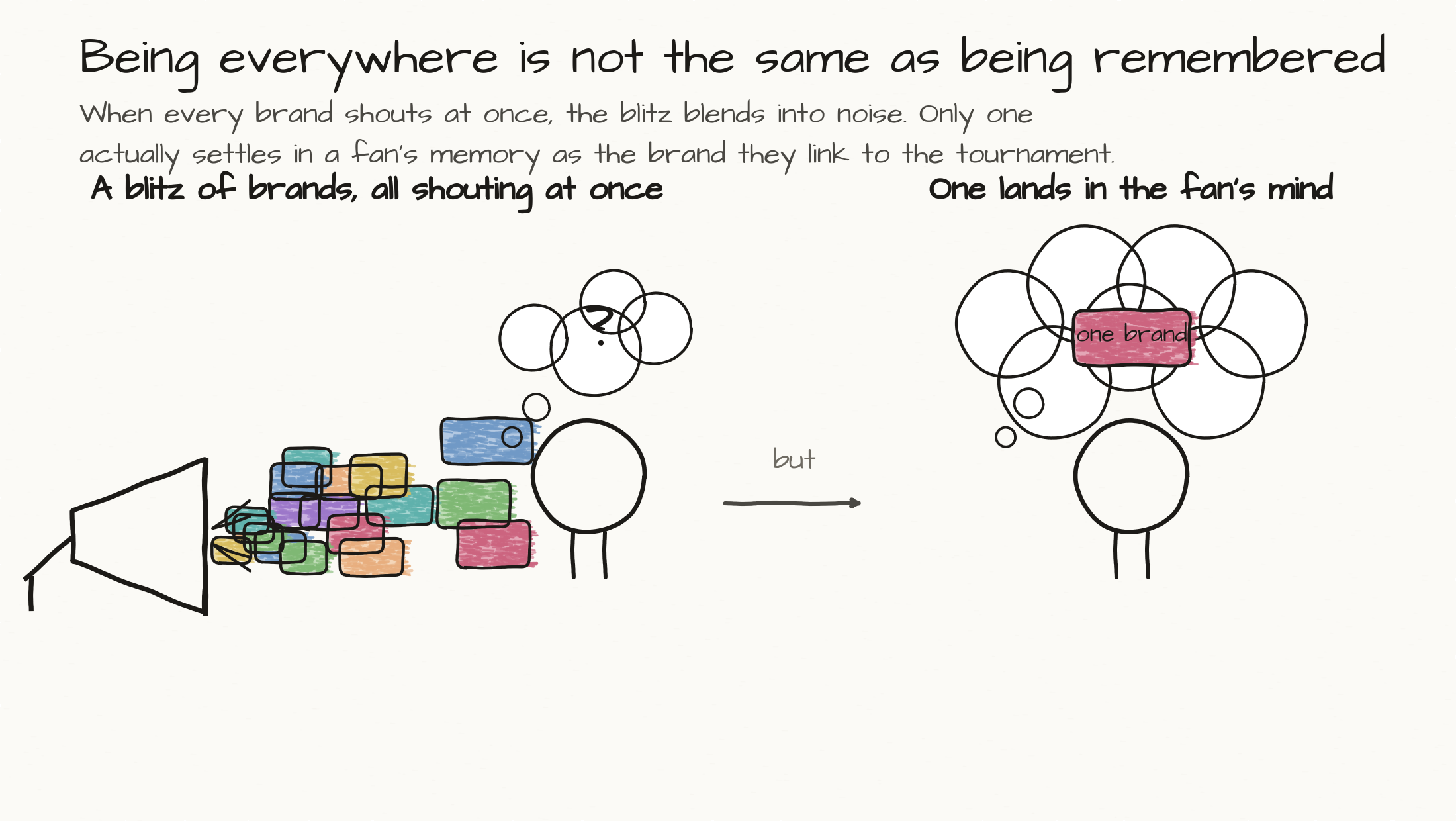
Sentiment was broadly positive — about eighty-nine percent across all coverage, with Hisense near 99.7 percent and AB InBev around ninety-three percent — though Airbnb drew negative coverage tied to housing concerns.11 The lesson is not that volume is worthless, but that in a saturated field it no longer buys distinctiveness on its own. Being heard and being remembered have become different problems.
05 · The Measurement Gap
Crowding erodes recall, and proof stays out of reach
Crowding does not just dilute attention; it measurably weakens memory. In research summarized by Harvard Business Review, recall of long-established sponsors fell from about seventy-three percent to about sixty percent once competing brands were shown in the same survey — a drop of roughly seventeen percent.12 Takeover effects at an event proved fragile too: a new sponsor's recall measured about twenty percent at the event but only twelve percent six months later, while an established sponsor held at forty percent.12
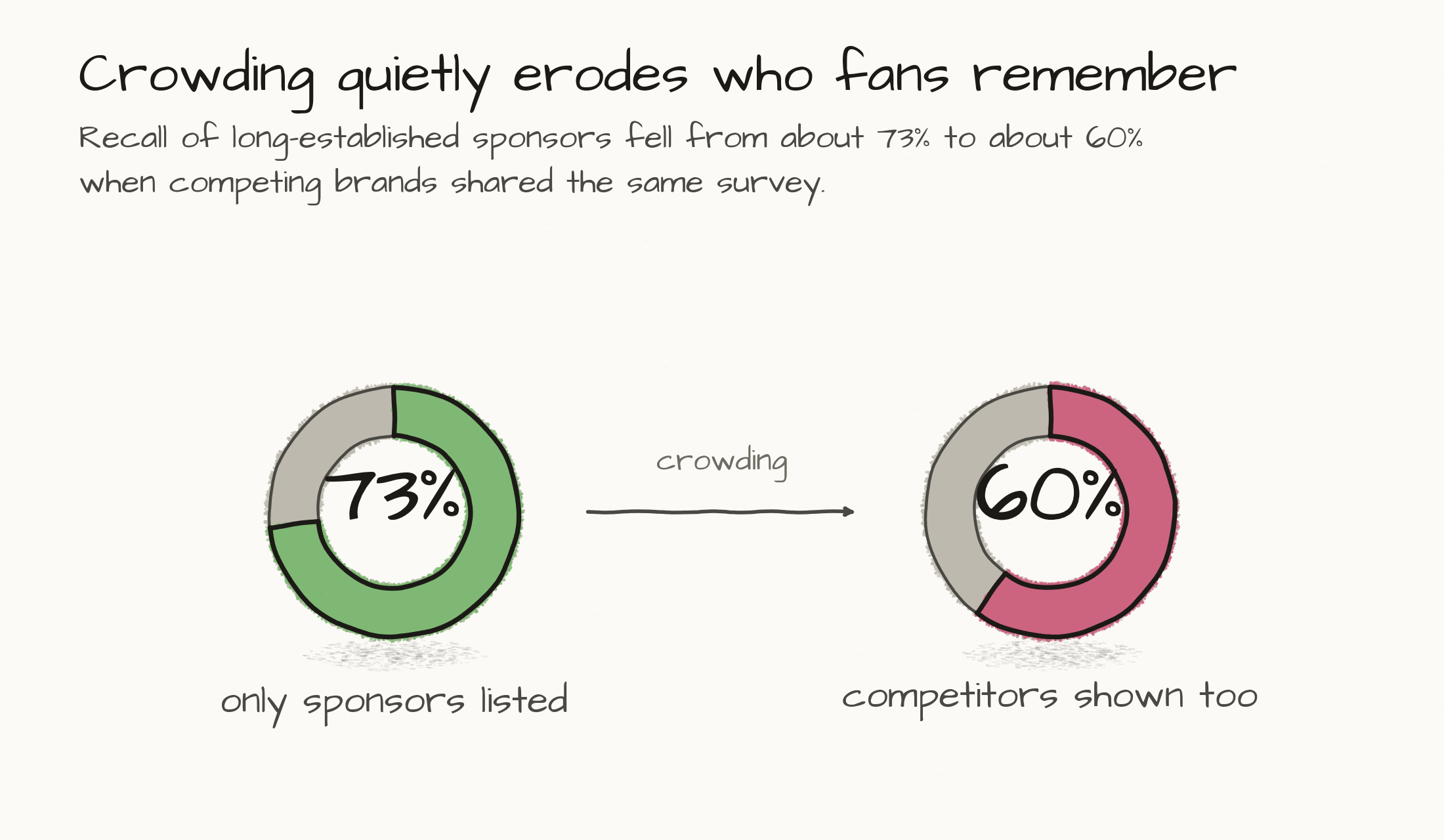
This is where the two halves of the argument meet. The spending is documented, but the proof of return is not. Industry analysts at Gartner project that by 2028, ninety percent of marketers who invest in sports sponsorships will struggle to demonstrate their value.13 The implication for 2026 is direct: the brands placing the largest bets are doing so without an agreed scoreboard, and the crowding that makes the event feel important is the same crowding that makes its payoff hard to measure.
The scoreboard that does exist
“No agreed scoreboard” does not mean no instruments. The measurement industry has built a layered toolkit, and a tier-one sponsor typically reads four of them together. Media value equivalency converts logo exposure in broadcast and in-stadium signage into a dollar-equivalent media figure; Nielsen's Return on Sponsorship Investment is the market standard, scoring reach, engagement, intent, and sales.20 Brand-lift studies use pre- and post-tournament survey waves, comparing viewers against matched non-viewers, to read shifts in awareness, consideration, and purchase intent. Earned media value prices the organic social conversation, multiplying creator and fan impressions by a platform cost-per-thousand benchmark.21 And marketing-mix modeling isolates the revenue attributable to the activation from every other marketing variable.22
Read together, those tools imply a set of pass/fail thresholds. The table below collects the benchmarks a tier-one sponsor would hold itself to — the targets that, met or missed, will eventually decide whether a 2026 bet is judged to have paid off.
| What it measures | Benchmark target | How it is read |
|---|---|---|
| Unaided awareness lift | +3 to 8% | Brand tracker (Ipsos / Kantar), viewers vs. non-viewers |
| Purchase consideration lift | +5 to 15% | Brand tracker survey waves |
| Broadcast logo exposure (MVE) | 1.5 to 3x cost | Nielsen logo tracking and media valuation |
| Earned media value (social) | 2 to 4x creator spend | Impressions × platform CPM benchmark |
| Ad recall vs. non-sponsor | Top-quartile score | Creative-effectiveness norms (System1 / Dynata) |
| Return on sponsorship (ROSI) | 1.5 to 3x cost | Marketing-mix modeling to justify renewal |
Benchmark ranges for a tier-one sponsor, compiled from the measurement frameworks cited. Targets are industry conventions, not WC2026 results.
The reason this study reports targets rather than outcomes is itself the point. Each of these figures is an outcome metric — jersey sell-through, brand-lift waves, earned-media tallies, modeled revenue — and outcome metrics are not published until weeks after a campaign ends, typically four to six weeks out. As of this writing the tournament has barely begun, so no sponsor has a verified return to show. The absence of results is not an oversight in the reporting; it is the literal state of the evidence, and it is exactly what “the scoreboard comes later” means. The instruments are built and the thresholds are known; what is missing is the post-tournament data that will read against them.
06 · The Upside
The audience is already there to be won
None of the measurement difficulty means the opportunity is hollow. Survey work on United States attitudes found that 47.5 percent of adults are interested in the 2026 World Cup, with 25.9 percent very interested, and 48.1 percent planning to follow it.14 Among Gen Y — millennials — interest climbs to 61.9 percent, and among senior decision makers it reaches 72.5 percent.14 Half of respondents, 50.2 percent, picked the United States as a team to support.14
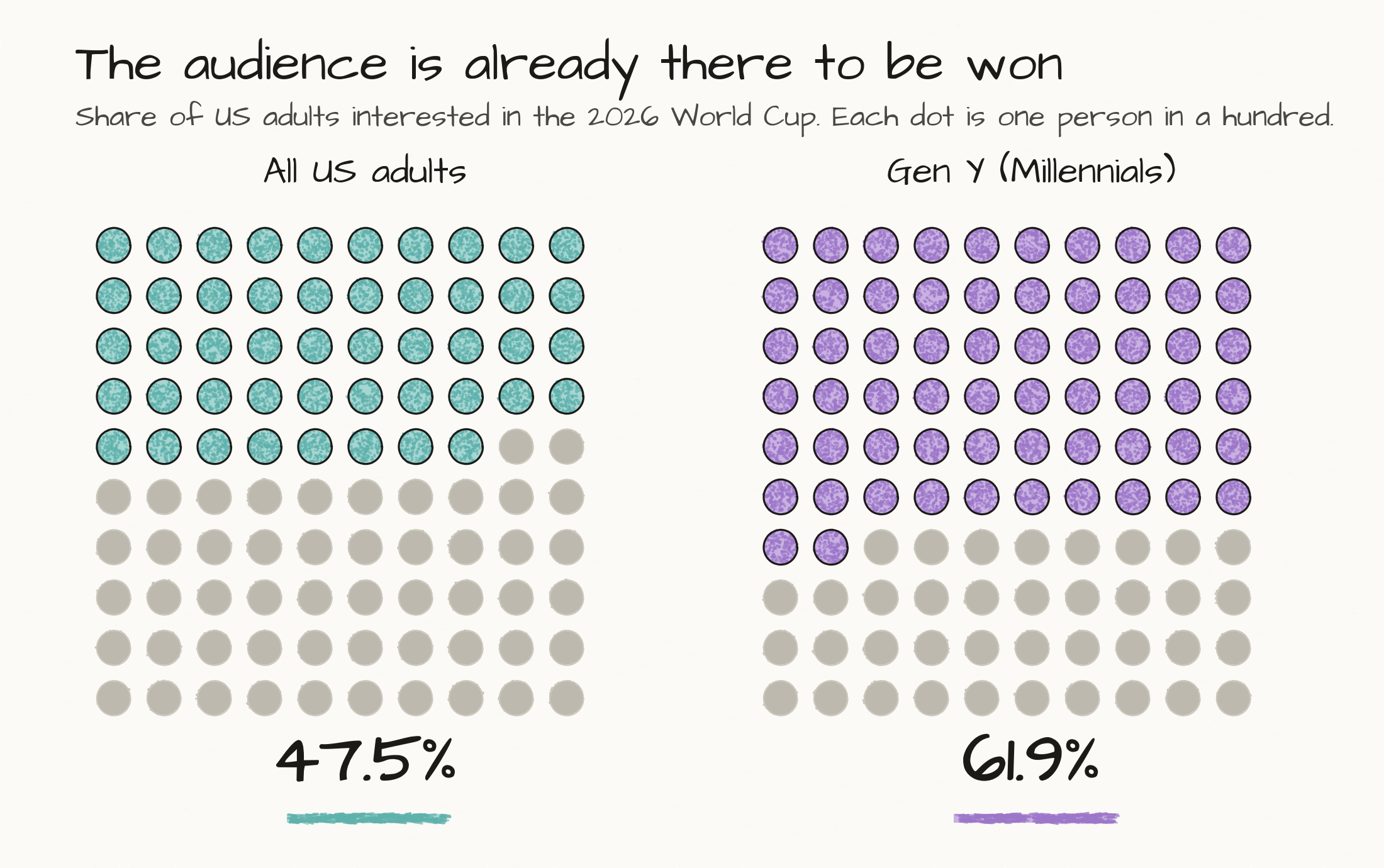
There is also early evidence that the right context converts attention into action. Retail media programs — such as Walmart Connect's work with Coca-Cola — lean on findings that sixty-two percent of shoppers bought a product after seeing an in-store screen ad.15 The demand is real and the conversion pathways exist. The unresolved question is not whether audiences will show up, but whether brands will be able to prove, after the fact, that their share of that audience justified the spend.
In Closing
A real bet, awaiting a real scoreboard
The case for 2026 is not in dispute on its first half. The scale is the largest the tournament has seen, the speed is unprecedented, and the dollars are documented down to the cycle. What has changed is the nature of the challenge. When everyone can afford to show up, showing up no longer distinguishes anyone. The brands that resonate are not the ones that shout loudest, crowding quietly erodes the memory that sponsorship is meant to build, and the analysts who study this expect most marketers to struggle to prove their return.
The audience is genuinely there to be won, and the upside is real. The honest conclusion is that the 2026 World Cup is a bet placed in full public view — and the scoreboard that would settle it has not yet been built. Everything in this study is offered in support of that reading of the evidence, not as proof that any single brand's bet will pay off.
A note on method and figures
Every numeric claim in this study is drawn from a published, attributable source listed in the citations that follow. The $6 to $8 billion total activation figure is identified as an industry estimate, not a published total. No event counts, percentages, or compression metrics have been derived or inferred beyond what the cited sources state.
Citations
Every figure, traced to its source
All figures and quotations in this study trace to the sources below. Where a number is an industry estimate rather than a published total, it is labeled as such in the body text.
Primary sources
- 1Biggest World Cup ever brings unprecedented sponsorship blitz to North America. Sports Business Journal (Terry Lefton), May 29, 2026. Format, host cities, Octagon and Genesco quotes, brand activations; sponsorship totals and U.S.-brand share via Ampere Analysis and the Sponsorship Marketing Association.
sportsbusinessjournal.com - 2World Cup: A tale of 16 cities. Sports Business Journal (Ross Silverman), June 1, 2026. FIFA 2023–2026 cycle revenue of about $13 billion; World Cups historically more than 80% of cycle revenue; format change from 64 to 104 matches.
sportsbusinessjournal.com - 3What Brands Get Wrong About Sports Sponsorships. Harvard Business Review (T. Bettina Cornwell), June 10, 2026. Tier-one fees of $150–200M and $400M+ over a four-year cycle; sponsor recall of about 73% falling to about 60% when competitors are shown; takeover-recall decay.
hbr.org - 4FIFA World Cup 2026 sponsors. Signal AI, November 6, 2026. Analysis of more than 100,000 articles across 24 sponsors: mention leaders, salience rankings (Hyundai #1; McDonald's 9th on mentions, 2nd on salience), and sentiment.
signal-ai.com - 5The World Cup will test marketers' ability to prove the value of sponsorships. Marketing Dive (citing Gartner's Nicole Greene), June 4, 2026. Gartner projection that by 2028, 90% of CMOs investing in sports sponsorships will struggle to prove ROI.
marketingdive.com - 6Inside U.S. audience attitudes to FIFA World Cup 2026. SPORTFIVE, June 10, 2026. U.S. interest of 47.5% (25.9% very interested); Gen Y 61.9%; senior decision makers 72.5%; 50.2% supporting the United States.
sportfive.com - 7The World Cup is a big chance for retail media to prove itself to advertisers. Digiday, June 12, 2026. Walmart Connect and Coca-Cola retail-media activation; 62% of shoppers purchased after an in-store screen ad.
digiday.com
Supporting context
- 8New York's World Cup cost. POLITICO, June 7, 2026. Public cost of about $503 million for the New York / New Jersey matches; FIFA expected to earn about $8 billion this year; $3.3 billion projected economic impact.
politico.com - 9Brand activation rollout, October 2025 to July 2026. Compiled by this study from a Google search of public announcements, June 12, 2026. The dated timeline in Section 03 is an illustrative compilation of publicly announced brand activations drawn from press coverage and company announcements; individual dates reflect announcement or launch timing as reported and are approximate. It is offered to show the pace and breadth of the rollout and is not an exhaustive or independently audited schedule.
Timing and measurement
- 10Global sponsorship packages for FIFA World Cup 2026 sold out. FIFA, March 27, 2026. FIFA's commercial framework and the sold-out sponsorship inventory ahead of the tournament, illustrating the fixed window in which official sponsors may activate.
inside.fifa.com - 11With the World Cup around the corner, media buyers expect streaming prices to soar. Digiday, April 2026. Streaming and broadcast prices expected to climb as the tournament approached, making spend placed near peak viewership more efficient per dollar.
digiday.com - 12Genius Sports and MediaScience study. Genius Sports, May 21, 2026. Controlled study finding that ads delivered immediately after emotionally heightened moments in live sport can roughly double unaided recall.
geniussports.com - 13Nielsen enables brands to maximize return on investment amid fast-changing sports sponsorship market. Nielsen, 2021. Return on Sponsorship Investment (ROSI) as a market standard scoring reach, engagement, intent, and sales.
nielsen.com - 14Earned Media Value (EMV). CreatorIQ. EMV defined as total impressions multiplied by a platform cost-per-thousand (CPM) benchmark to price organic social conversation.
creatoriq.com - 15FIFA World Cup Sponsorship: Is It Worth It? Analytic Partners, 2025. Marketing-mix modeling to isolate sponsorship-driven revenue from other marketing variables; ROSI thresholds used to justify renewal.
analyticpartners.com
Opening weekend
- 16World Cup 2026 live updates: USA opens with a win. ABC7 / Associated Press, June 13, 2026. United States beat Paraguay 4–1 before a sold-out 70,492 at SoFi Stadium; biggest U.S. World Cup win and first time scoring four in the tournament.
abc7news.com - 17Canada vs. Bosnia and Herzegovina: World Cup 2026 result. ESPN, June 12, 2026. Canada drew 1–1 with Bosnia and Herzegovina (Cyle Larin, 78') for its first-ever World Cup point; companion to Mexico's 2–0 win over South Africa, the tournament's first goal and win.
espn.co.uk - 18World Cup kicks off in U.S. as Katy Perry, Future headline opening ceremony. Al Jazeera, June 13, 2026. Hollywood-style opening ceremony featuring Katy Perry; Dan + Shay performed the United States national anthem (per The Sporting News).
aljazeera.com
Figures reflect sources published through June 2026 and are subject to revision as the tournament proceeds. The $6–$8 billion total activation figure is an industry estimate, not a published total.
The bet is placed.
The scoreboard comes later.
The 2026 World Cup Brand Mobilization
Download the PDF version